How Does Iridescence Work? Unveiling the Science Behind Shimmering Colors
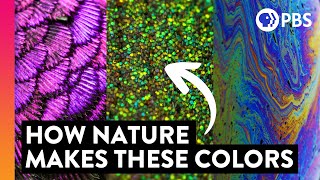
Iridescence is the dazzling, color‑shifting effect that makes a peacock’s tail, a beetle’s shell, or a soap bubble seem to change hue as you move. Although it looks like a miniature rainbow, the phenomenon is rooted in physics, not pigments. In this article we explore the mechanisms that create iridescent colors, the role of structural coloration, and why nature has evolved such striking displays.
What Is Iridescence?
When light strikes a surface and the reflected colors vary with viewing angle, the surface is said to be iridescent. The word comes from the Greek iris, meaning rainbow, because the effect often resembles a faint spectrum. Unlike pigments, which absorb certain wavelengths, iridescence is produced by the way light interacts with microscopic structures.
Structural Color vs. Pigment Color
Most everyday colors come from pigments that absorb some wavelengths of visible light and reflect others. Structural color, on the other hand, arises from physical structures that manipulate light through interference, diffraction, or scattering. These structures are typically on the scale of nanometers to micrometers—comparable to the wavelength of visible light.
- Thin‑film interference: Layers of material cause light waves to reflect at slightly different depths, creating constructive and destructive interference.
- Diffraction gratings: Regularly spaced ridges split light into its component colors, similar to a prism.
- Photonic crystals: Three‑dimensional lattices that affect the propagation of light in multiple directions.
Thin‑Film Interference: The Classic Iridescent Mechanism
The most common explanation for iridescence involves thin‑film interference. When light hits a thin layer—such as the keratin in a bird feather or the wax on a soap bubble—part of the light reflects off the top surface, while the rest penetrates the film, reflects off the bottom surface, and then exits. The two reflected waves travel different distances; depending on the film’s thickness and the light’s wavelength, they may reinforce (constructive interference) or cancel (destructive interference) each other.
Because the path difference changes with the angle of incidence, the specific wavelengths that are reinforced also change. This is why a peacock feather appears green when viewed head‑on but shifts to blue or gold as the observer moves.
Diffraction Gratings and Photonic Crystals
Some insects and birds achieve iridescence with more complex nanostructures. The scales of a Morpho butterfly, for example, contain a series of ridges spaced at regular intervals. These ridges act as a diffraction grating, separating incoming white light into a spectrum that is then reflected back to the viewer.
In other cases, such as the shells of certain beetles, the material forms a photonic crystal. This three‑dimensional lattice creates a “stop band” that reflects specific wavelengths while allowing others to pass through, resulting in vivid, angle‑