Propositions And Connectives: An Introduction to Propositional Logic
Welcome to the first video in our new Discrete Math playlist. In this article, we will delve into the fascinating world of propositional logic, a fundamental concept in the study of discrete mathematics. We will explore what propositions are, how we can determine their truth values, and the role of connectives in forming complex logical statements.
Understanding Propositions
At the heart of propositional logic are propositions, which are declarative statements that can be either true or false, but not both. They are the building blocks of logical arguments and form the basis for more complex logical structures.
For example, consider the following statements:
- "The sky is blue."
- "2 + 2 = 5."
- "It is raining."
The first statement is true, the second is false, and the third's truth value depends on the current weather conditions. These are all examples of propositions.
Truth Values and Determining Truth
As mentioned earlier, propositions can be either true or false. The truth value of a proposition is determined by the facts it represents. For instance, the proposition "The Earth is round" is true, while "The Earth is flat" is false.
In some cases, the truth value of a proposition may not be immediately apparent or may change over time. For example, the proposition "It is raining" is true if it is currently raining and false otherwise. The truth value of such propositions can be determined by observing the current state of the world.
Introducing Connectives
Connectives, also known as logical operators, are symbols or words used to combine propositions and form more complex logical statements. They help us to express relationships between propositions and to determine the truth value of the resulting statement.
Some common connectives in propositional logic include:
- Negation (¬ or NOT): This connective is used to negate a proposition. If the original proposition is true, the negated proposition is false, and vice versa.
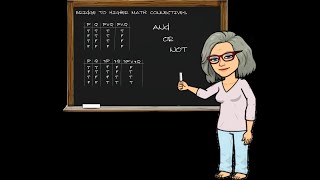
- Conjunction (∧ or AND): This connective is used to combine two propositions. The resulting statement is true only if both original propositions are true.
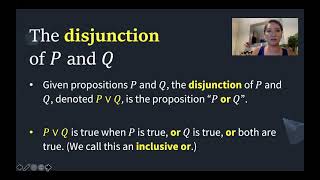
- Disjunction (∨ or OR): This connective is used to combine two propositions. The resulting statement is true if at least one of the original propositions is true.
- Implication (→ or IF...THEN...): This connective is used to express a conditional relationship between two propositions. The resulting statement is false only when the first proposition is true and the second is false.
- Biconditional (↔ or IF AND ONLY IF): This connective is used to express a bidirectional conditional relationship between two propositions. The resulting statement is true only when both propositions have the same truth value.
Forming Complex Logical Statements
By using connectives, we can form complex logical statements by combining simpler propositions. For example, consider the following propositions:
- P: "It is raining."
- Q: "The ground is wet."
We can use the implication connective to form the statement "If it is raining, then the ground is wet" (P → Q). This statement is true in most cases, as rain typically causes the ground to become wet.
Similarly, we can use the conjunction connective to form the statement "It is raining and the ground is wet" (P ∧ Q). This statement is true only when both propositions P and Q are true.
Truth Tables
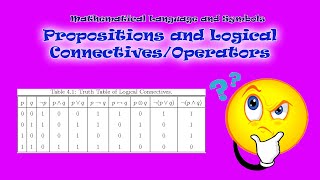
Truth tables are a useful tool for determining the truth value of complex logical statements. A truth table lists all possible truth values of the propositions involved and the resulting truth value of the statement for each combination.
For example, consider the